
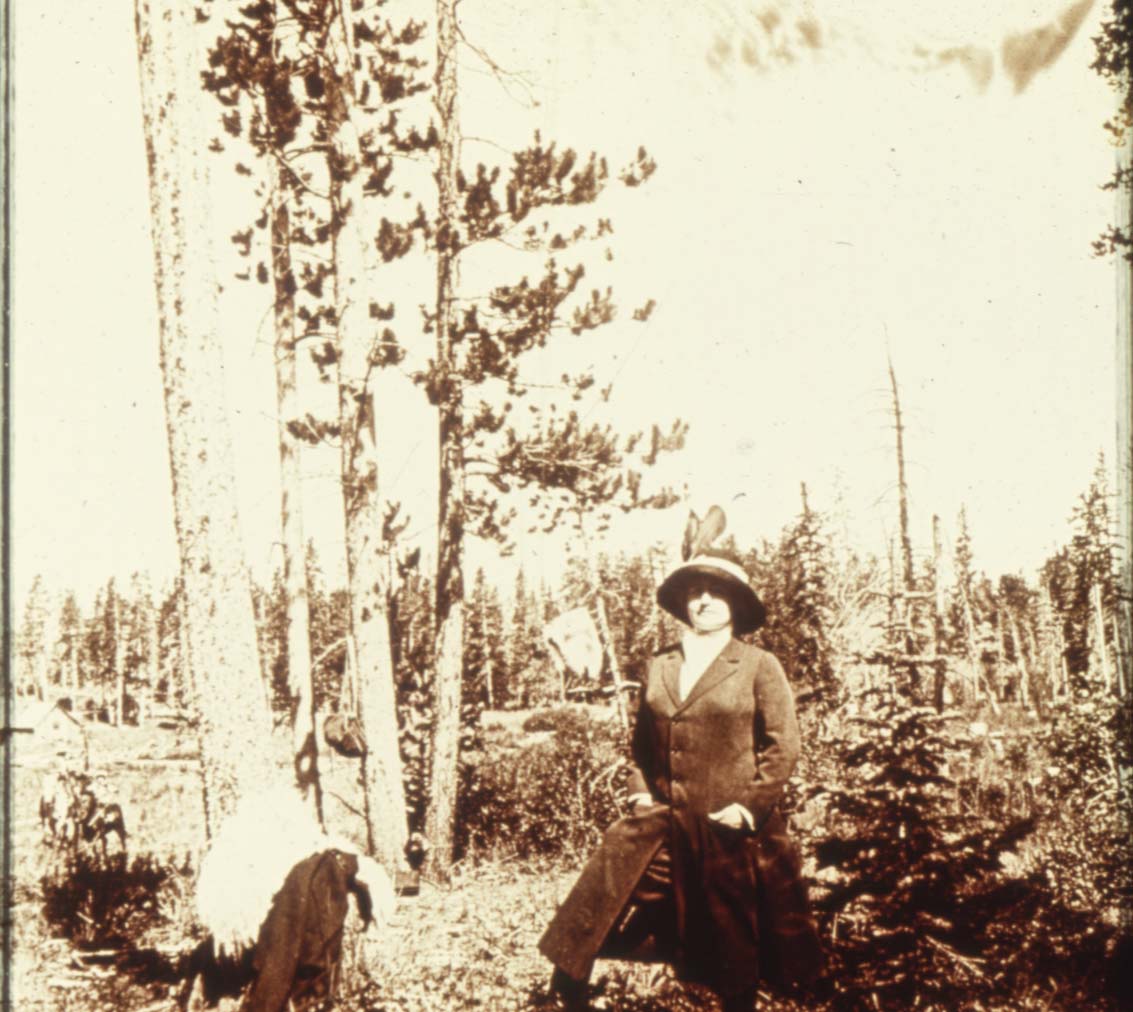
This February, as we celebrate the season of camellias and Valentine’s Day, we’re taking a closer look at Mai Rogers Coe (1875 – 1924), a key figure at Planting Fields. The central theme of Mai’s story, beyond her great wealth and pedigree, is her health; she suffered from a constellation of issues but was never provided with a specific diagnosis. It’s through the archives that we learn about her well-being, however, everything we know about Mai is derived from letters written by W.R., not in her own voice.
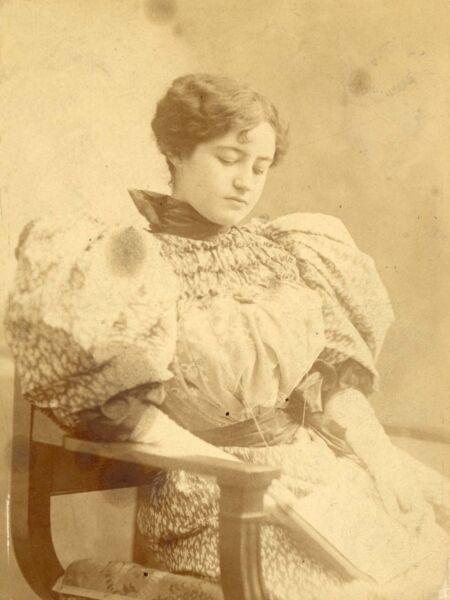 Mai Rogers, age 21, photographed by Aime DuPont in 1896.
The Cure 1894-1899
Before her marriage to W.R. in 1900, letters between her father Henry Huttleston Rogers and his friend Samuel Clemens (Mark Twain) offer a glimpse of her early life. On March 20, 1894, Rogers wrote that Mai, at age 19, “came near to being asphyxiated at school a short time since and is in an enfeebled condition in consequence.” She was accidentally exposed to gas while staying at a convent school in New York City and “her blood is in wretched condition, and her heart is somewhat out of order all of which the Doctor thinks will be improved by a change.”i Shortly after Mai was sent to Europe – going abroad was often prescribed for women of means to find resolution and the distance required to gain perspective. The voyage by sea, the abundance of fresh air and unfettered views of the horizon were essential to the transformation.
After Mai’s annulled marriage to Joseph Cooper Mott in 1896 she once again went overseas. On June 6, 1899, Clemens wrote to Rogers “I am so sorry her health is affected, and very-very sorry she has to go as far as Switzerland. She would find it much more agreeable to take her dinners and lunches with us than with strangers.” He later wrote that “Miss Mai ought to join us in Sweden and try that cure. I am sure of it.” Mai was likely sent to Switzerland for the curative effects of the fresh mountain air; Clemens implies that Mai would be better off in Sweden where his daughter Jean was receiving treatment at a sanitarium.
Neuritis 1919
W.R.’s letters to his children, who were away at school always included a line about “mother.” Twenty years after her Switzerland sojourn she received a significant diagnosis. In March 1919, after several weeks of illness, her doctors advised that she go to Dr. Foord’s Sanitarium in the Catskills. She was diagnosed with neuritis, a painful condition that occurs when nerves become inflamed. Unfortunately, there wasn’t any room at the sanitarium, and W.R. reported that “While the neuritis in her body is better, unfortunately it extended to the head and caused inflammation of the brain.” He later responded to his son Robert that, “she is suffering from nervous exhaustion and some intestinal disturbance. With care, and if she takes more exercise, she will come out all right.” This statement implies that Mai’s illness may have been twofold: frustration at not finding relief alongside the physical impact of her ailments. It also indicates an emphasis on exercise – fresh air and the great outdoors as the great cure-all.
 “Neuritis—a Fad” by Dr. William Brady, courtesy of Newspapers.com
Neuritis is mentioned in publications and medical journals during the early 1900s, often in connection with hand pain or injured nerves. Treatment included electrical applications, heat, and analgesics. According to an article published in the Brooklyn Daily Eagle in 1935, long after Mai’s diagnosis, neuritis was deemed a “fad” and characterized along with neurasthenia, as a catch-all term for physical and mental exhaustion.
 Postcard of Ford’s Sanitarium from 1927.
Dr. Fitz Foord’s sanitariumii was in Kerhonkson in the Catskills region of New York. His retreat was popular among literary figures such as E.B. White, James Thurber, and O. Henry, who typically went there to restore themselves in a country setting far from the stress of the city.
The Great Outdoors 1919-1924
Mai had a long recovery and eventually was able to return to Planting Fields (from New York City, where she was being cared for) later that fall of 1919. W.R. noted how much Mai delighted in being taken around Planting Fields in a wheelchair and that she is “taking quite an interest in the place.” Mai was involved in many of the design decisions and it’s probable that this sense of agency helped improve her spirits.
A few years later in the summer of 1924, Mai had an attack of jaundice at the ranch in Wyoming, and her stomach became painfully extended. According to W.R., the jaundice also affected her liver. She was later moved to the St. Regis Hotel in New York City, to be closer to her doctors. W.R. corresponded with Robert in Oxford, England, who was eager to travel home to be with his mother. In this cablegram, W.R. urges Robert to wait until Christmas to avoid alarming Mai. Robert didn’t wait much longer and sailed on the USS Leviathan in November.
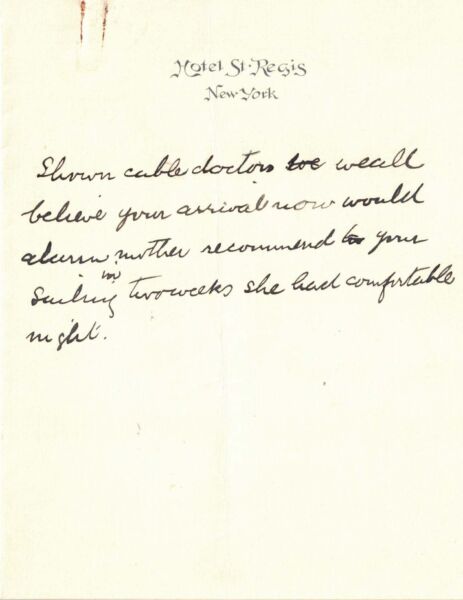 Outline of telegram written by W.R. to Robert from Hotel St. Regis.
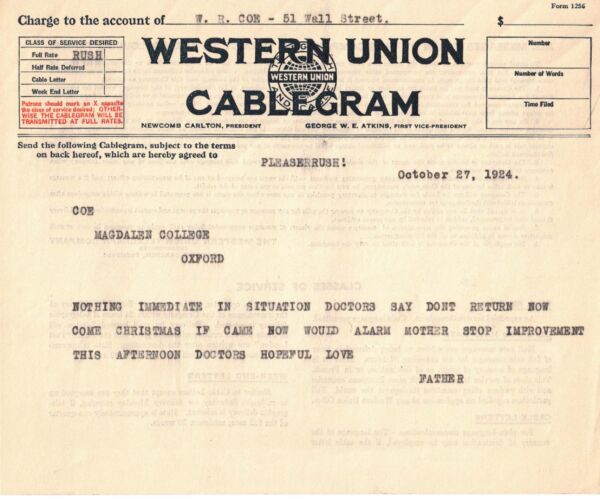 Cablegram from W.R. to Robert, October 1924.
 Radiogram from Mai to Robert, November 1924.
On December 28, 1924, at the age of 49, Mai died at the St. Regis Hotel. The cause of death according to her death certificate was broncho-pneumonia with a secondary cause of chronic perihepatitis.
This post is intended to take a closer look at Mai’s health through the lens of the letters by her father and husband. It also highlights the way that health was written about, discussed and treated during the early 20th century.
–– From Michael D. Coe Archivist, Marie Penny
Header: Mai Coe in Wyoming, circa 1910.
All images Planting Fields Foundation unless otherwise noted.
i Leary, Lewis (Eds). (1969). Mark Twain’s Correspondence with Henry Huttleston Rogers 1893-1909. University of California Press.
ii The spelling of sanitarium widely varies, often depending on the country of origin or the doctor involved. Clarification of this term provided by the excellent Sun Seekers: The Cure of California by Lyra Kilston (Atelier Editions, 2019).
Wonderful research, thank you. I had been aware that Mai had health problems & it is interesting to read about them in the context of the times she lived in.